
Reviewed · ART NOUVEAU TOURS
Riga: 2-Hour History of Art Nouveau Walking Tour
Riga turns apartment blocks into public art. I like the way this two-hour walk connects the Old Town with Riga’s celebrated Art Nouveau district, and I especially like that it explains both the beauty and the practical ideas behind the style. Guides such as Tatiana, Gunta, Caspars, Liga, and Nelli have earned praise for clear explanations, friendly service, and close attention to architectural detail.
The main consideration is pace and audience. The walk is easy enough for most people, but children over six pay the full price and may lose interest before the end. The tour also requires at least three participants, so a small booking could be cancelled or changed to a private option.
In This Review
- Key points to know before you book
- Why Riga is such a good place for Art Nouveau
- Starting at the House of the Black Heads
- Walking from the Old Town to the Art Nouveau district
- Mikhail Eisenstein and Riga’s theatrical facades
- Alberta Street and the many faces of Art Nouveau
- How the guide changes what you see
- Group size, pace, and comfort
- Is $39 a fair price?
- Who should book this walking tour?
- Booking advice and final verdict
- FAQ
- Where does the Art Nouveau walking tour meet?
- How long is the walking tour?
- Which languages are available?
- Is the tour wheelchair accessible?
- Are entry tickets included?
- Can children join the tour?
Key points to know before you book
- The route begins at the House of the Black Heads: Meet at the Smile Line office in Townhall Square, 7, then walk from central Riga toward the Art Nouveau district.
- Mikhail Eisenstein gets special attention: You learn about the controversial architect behind some of Riga’s most theatrical facades.
- Alberta Street is the visual high point: This famous street brings together decorative, intellectual, and national romantic versions of Art Nouveau.
- The tour is about ideas, not just photographs: Your guide explains how Art Nouveau aimed to unite beauty and function.
- Small groups can make a real difference: A group of under 10 people was praised for creating an easy, personal atmosphere.
- English and German are standard: Other languages may be arranged on request, including Swedish, Norwegian, Polish, Spanish, Portuguese, French, Italian, and Japanese.
Why Riga is such a good place for Art Nouveau
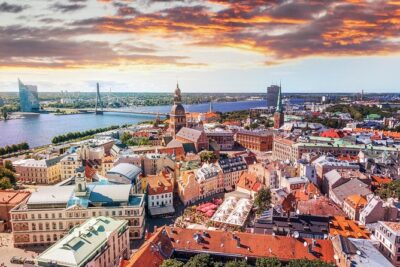
Riga is unusually rewarding for anyone interested in architecture because its Art Nouveau buildings are concentrated in a walkable central area. You do not need to chase isolated monuments across the city. A short route can show you several different interpretations of the style, often within the same neighborhood.
Art Nouveau appeared in Riga when the city was an important port of the Russian Empire. Architects from Latvian, German, Russian, and Jewish backgrounds contributed to the city’s changing appearance. That mix matters. Riga’s architecture is not the product of one designer or one national tradition.
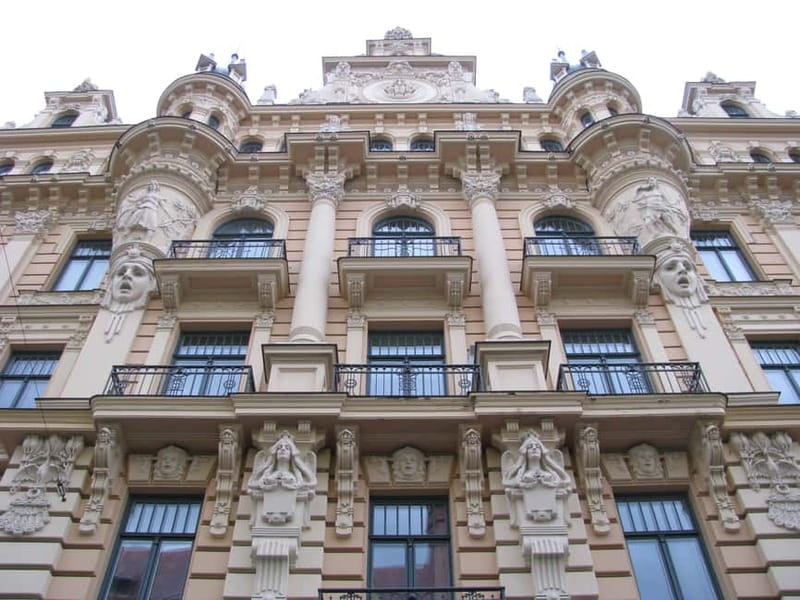
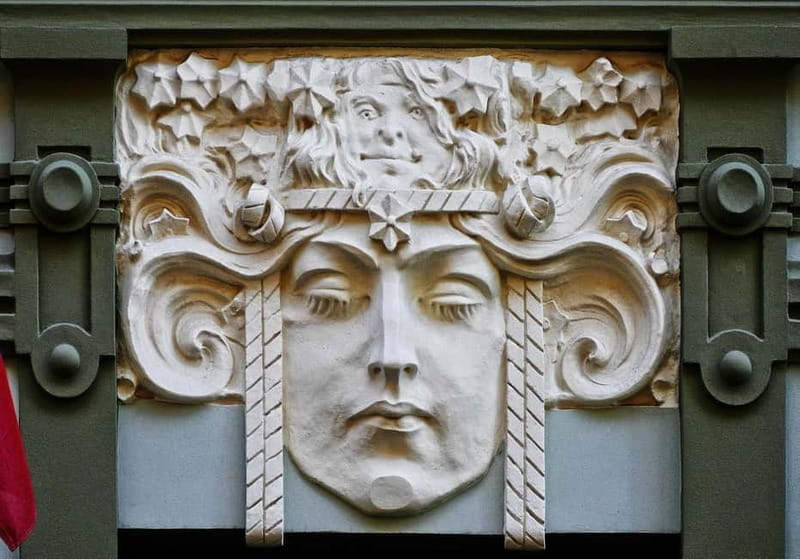
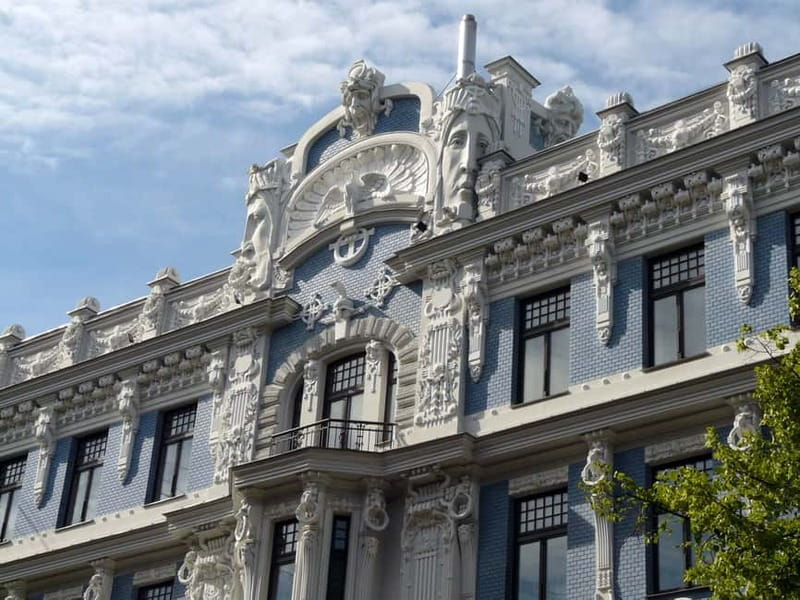
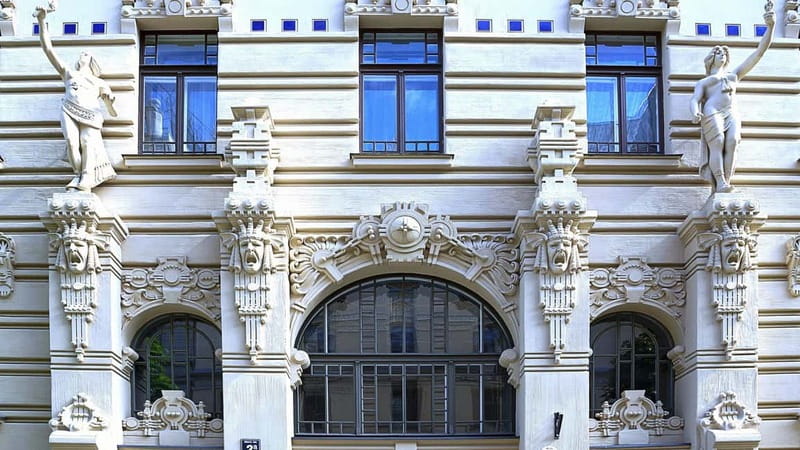
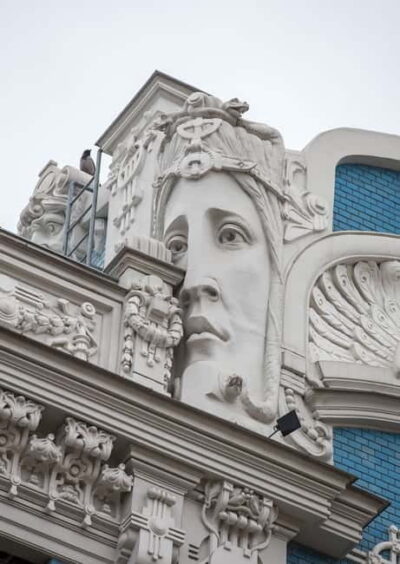
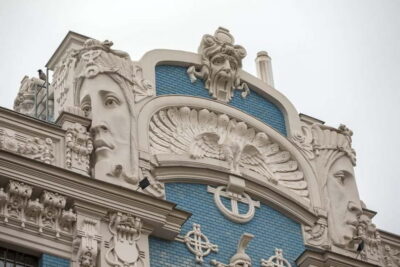
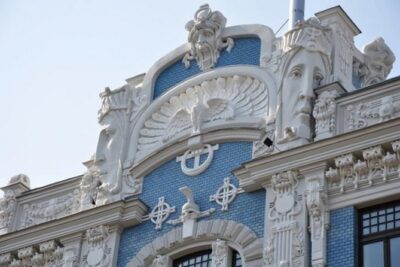
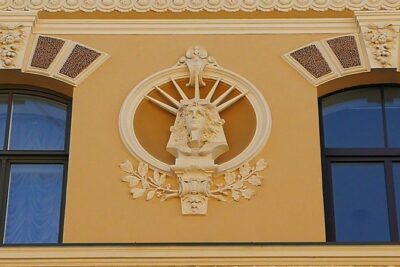
You will see buildings covered with sculpted faces, plant forms, geometric patterns, and dramatic figures. You will also see quieter facades shaped by national romantic ideas, with heavier materials and a more restrained mood. The contrast helps you understand that Art Nouveau was never one fixed look.
I particularly like the tour’s focus on function. It is easy to photograph an elaborate doorway and move on. A good guide asks you to consider the whole building: how the entrance works, how decoration frames the windows, and how the design fits the street. The central question is simple: can something be both useful and beautiful?
More Art Nouveau walks in Riga:
- Riga: Old Town Walking Tour with Art Nouveau Highlights
★ 4.7 · 332 reviews - Riga Art Nouveau walking tour
★ 4.0 · 27 reviews - Walking Tour of Riga’s Beautiful Art Nouveau Architecture
★ 4.8 · 20 reviews
Starting at the House of the Black Heads
The meeting point is the Smile Line office inside the House of the Black Heads at Townhall Square, 7. This gives you a clear, central place to begin, and it puts the tour in the middle of Riga’s Old Town rather than sending you straight to the Art Nouveau district.
The House of the Black Heads is itself one of Riga’s most recognizable buildings, so allow enough time to find Townhall Square and the office. Your tour is a walking experience from the start. Wear comfortable shoes, especially if you plan to continue exploring after the two-hour route.
Beginning in the Old Town also gives the guide a chance to place Art Nouveau in the wider story of Riga. The route then moves toward the district where the style is most concentrated. That transition is useful because you are not simply dropped in front of a row of ornate facades without context.
The tour is wheelchair accessible, according to the activity details. Some routes may change, so the exact order of streets and buildings is not guaranteed. That is worth remembering if you have planned your own schedule around a specific stop.
Walking from the Old Town to the Art Nouveau district
The first part of the route connects Riga’s historic center with the streets known for Art Nouveau. This is not a bus tour, so you see the city at street level and have time to notice how architectural styles change as you walk.
A guide can point out details that are easy to miss on your own. You may notice how ornament is placed above eye level, how a doorway sets the tone for an entire building, or how neighboring facades differ in color, scale, and decoration. The tour turns looking upward into a useful habit.
Several people praised the guides for making the walk easy to follow. One person specifically liked the relaxed pace, while another appreciated an audio system that made it possible to hear the guide while walking and looking at the buildings. That can be especially helpful on a city street where traffic and other groups create background noise.
The route is still a two-hour walk, not a museum visit. You will spend most of the time outside, and there are no entry tickets included. If you want to see an interior museum or enter a particular building, plan that separately.
Mikhail Eisenstein and Riga’s theatrical facades
Mikhail Eisenstein is one of the tour’s central figures. He is presented as a talented but controversial architect whose work gives Riga some of its most dramatic Art Nouveau scenes.
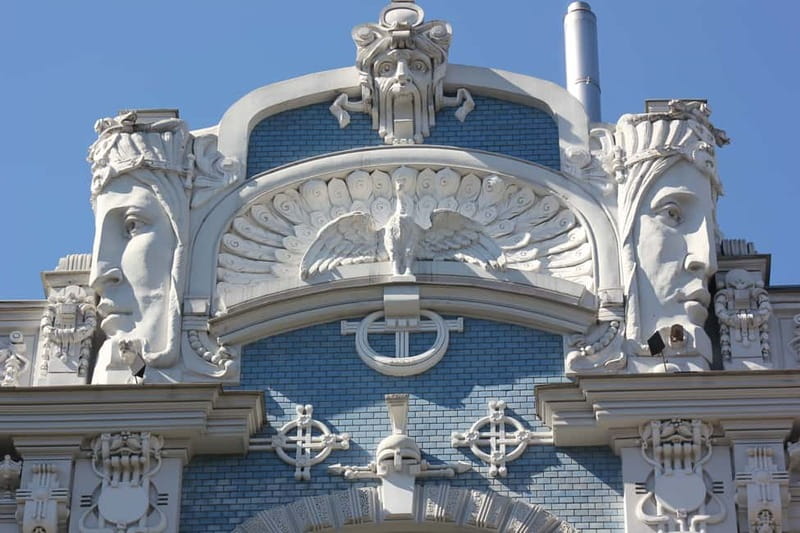
His buildings are useful for understanding the highly decorative end of the style. Look for facades that seem almost theatrical, with strong symmetry, expressive faces, sculptural ornament, and bold visual effects. These buildings are not shy. They demand your attention from the sidewalk.
The guide also places Eisenstein in his historical setting. He lived and worked in Riga when the city was a major port within the Russian Empire. That context helps explain why the city attracted architects and clients with different cultural backgrounds and different ideas about modern design.
I would not expect a long academic lecture on Eisenstein. The value is in seeing his work while hearing the story attached to it. Once you know what to look for, an ornate facade becomes more than a pretty background for a photograph.
Eisenstein’s work also provides a useful contrast with the quieter buildings nearby. Some facades shout across the street. Others use natural forms, local references, or simpler geometry. Seeing them together makes the district feel like a debate between architects rather than a collection of matching buildings.
More walking tours in Riga:
- Riga: Guided Old Town Walking Tour
★ 4.8 · 1,049 reviews - Riga Old Town walking tour
★ 4.5 · 304 reviews - Riga: Old Town Walking Tour in a Small Group or Private
★ 4.7 · 254 reviews - Riga: Private Walking Tour with a Local
★ 4.7 · 168 reviews
Alberta Street and the many faces of Art Nouveau
Alberta Street is the tour’s essential stop. It is one of Riga’s best-known Art Nouveau streets, and the concentration of striking buildings makes it easy to understand why the city is associated with the style.
You will likely spend time examining facades rather than rushing past them. The guide can draw your attention to ornament, composition, and the stories behind the architects. This is where the walking format works best: you can stop, look up, compare buildings, and ask questions.
One of the strongest features of the route is its variety. Some buildings are highly decorative, with elaborate surface detail and sculpted elements. Others lean toward a more intellectual design, where the structure and proportions matter as much as the ornament.
The tour also explains national romanticism, an approach that brought national identity and local character into architectural design. You may find these buildings less flamboyant than Eisenstein’s work, but they can be just as interesting. Their appeal comes from the way design communicates place and identity.
The city’s Latvian, German, Russian, and Jewish architects each contributed distinctive ideas. You should not expect every building to fit neatly into a single category. That is part of the pleasure. Riga’s Art Nouveau district rewards comparison.
How the guide changes what you see
Without a guide, you can enjoy Riga’s buildings at face value. With a good guide, you begin to read them.
The strongest praise for this tour has focused on the guides’ preparation, passion, and ability to answer questions. Tatiana is repeatedly praised for being engaging and exceptionally well informed. Gunta is noted for carefully showing the important landmarks and responding attentively. Caspars is praised for organization and attention to small details, while Liga and Nelli also received warm comments for making the subject clear and enjoyable.
Those details matter because architecture tours can easily become a parade of names and dates. Here, the best experience seems to come from connecting the visible building to a bigger idea. Why is one facade so ornate? Why does another feel more serious? What does a symbol or sculpted figure add to the design?
You may also receive useful local suggestions at the end. One guide offered recommendations for shops and cafes, which is handy if you want to continue exploring central Riga after the walk.
The tour is available in English and German. Other languages can be requested, including Swedish, Norwegian, Polish, Spanish, Portuguese, French, Italian, and Japanese. Since those languages are available only upon request, arrange that before booking rather than assuming it will be offered on the day.
Group size, pace, and comfort
This is a group tour with a minimum of three participants. If there are not enough bookings, the activity may be cancelled with a full refund, or you may be offered the chance to upgrade to a private tour.
A small group is a real advantage on an architecture walk. You can hear more easily, ask questions without holding up a large crowd, and gather around a facade without creating a human traffic jam. A group of under 10 people was described as particularly personal.
The pace appears comfortable rather than hurried. That suits the subject. Art Nouveau details are often high above the sidewalk, and you need time to look properly. One person also praised the audio equipment, which can make a noticeable difference when the guide is speaking while the group is moving.
Bring comfortable shoes. The route is wheelchair accessible, but a walking tour through central Riga can still involve ordinary city-street conditions. If you have limited mobility, confirm the current route when booking, since some excursions may change direction or stops.
Children under six can join for free. Older children pay the full price, and one family found that children became bored toward the end. I would choose this tour for adults, older children with a real interest in buildings, or families prepared to keep younger participants engaged.
Is $39 a fair price?
At $39 per person, the tour is not the cheapest way to look at Riga’s facades. You can walk through the Art Nouveau district on your own without paying an admission fee. The real question is what you want from the visit.
If you only want photographs, a self-guided walk may be enough. If you want to understand the architects, the cultural mix, Eisenstein’s role, and the difference between decorative Art Nouveau and national romanticism, the price is easier to justify.
You are paying for two hours with a live guide, not for entry to a museum or a private vehicle. There are no entry tickets included, so budget separately if you plan to visit paid attractions during the day.
The value is strongest for a first visit to Riga. A guide helps you get your bearings and shows you details that you might otherwise overlook. One solo visitor also appreciated the security and confidence of exploring with a local guide rather than walking through an unfamiliar area alone.
The high rating of 4.8 from 118 ratings fits the overall picture: the most praised elements are the guides, the clear explanations, the easy pace, and the chance to see far more than you might notice under your own steam.
Who should book this walking tour?
I would recommend it to first-time visitors who want an introduction to Riga’s architecture without spending half a day in a museum. It also suits anyone who enjoys city history, design, photography, or the small details above street level.
It is a good choice for solo visitors. The group setting gives you company without requiring a full-day commitment, and the central meeting point is practical if you are already in the Old Town.
Couples and friends will get the most from it if they are willing to look closely and listen. The tour is less suitable if you dislike guided walks, want to move at your own pace, or have children who are likely to tire of architectural explanations.
You should also book with realistic expectations. This is not a private tour, and the exact route can change. You may not enter buildings, and the most memorable parts happen outdoors. Still, the compact format gives you a strong introduction without taking over your entire day.
Booking advice and final verdict
I would book this tour early in a Riga stay, preferably near the beginning. The guide can help you recognize the city’s architectural styles, and you may then notice more as you explore on your own.
The free cancellation policy allows you to cancel up to 24 hours before the tour for a full refund. You can also reserve now and pay later, which helps if your schedule is still shifting.
Book it if you want more than attractive facades. The strongest reason to go is the combination of a manageable two-hour route, a small-group feel, and guides who explain why the buildings look the way they do.
Skip it if your interest in architecture is slight, you need a completely flexible route, or you are traveling with young children who will not enjoy a long look at buildings. For most adults and older children with curiosity about Riga, $39 is a reasonable price for a clear, engaging introduction to one of the city’s defining features.
FAQ
Where does the Art Nouveau walking tour meet?
Meet the guide at the Smile Line office in the House of the Black Heads, Townhall Square, 7, in central Riga.
How long is the walking tour?
The tour lasts two hours. Check the available starting times when booking.
Which languages are available?
The regular tour languages are English and German. Swedish, Norwegian, Polish, Spanish, Portuguese, French, Italian, and Japanese may be available upon request.
Is the tour wheelchair accessible?
Yes, the activity is listed as wheelchair accessible. Some excursions may have route changes, so confirm the current route if accessibility is important for your visit.
Are entry tickets included?
No. The tour includes the local guide and the two-hour walking experience, but entry tickets are not included.
Can children join the tour?
Children under six can join for free. Children over six are charged the full price, and one family found that older children became bored near the end.
More history tours in Riga
- Riga: Canal & Daugava Cruise on a Historic Wooden Boat
★ 4.4 · 496 reviews - Old Riga in Italian: History&Legends
★ 4.8 · 125 reviews - Riga: Jewish History and Heritage Tour
★ 4.9 · 25 reviews - Riga’s Jewish Heritage: A 2 h Walking Tour in a small group
★ 4.2 · 11 reviews
New on the site around Riga
- Vilnius Day Trip or Airport Transfer★ 5.0 · 2 reviews
- Wooden Riga on foot -Ķīpsala★ 5.0 · 2 reviews
- Ultimate Art Nouveau Experience in Riga – Private Tour★ 5.0 · 4 reviews
- Tour from Riga to Vilnius: Bauska Castle, Rundale Palace and The Hill of Crosses★ 5.0 · 3 reviews
- Private Transfer to anywhere in Riga Center★ 5.0 · 2 reviews
- The Best Of Riga Walking Tour★ 5.0 · 2 reviews
- Neigbourhoods of Riga: Honest tour through most beautiful and most unusual areas★ 5.0 · 2 reviews
- Taste Riga – Private Tour of Latvian Flavour★ 5.0 · 5 reviews
Art Nouveau Tours, compared.
Old Town Walking Tour with Art Nouveau Highlights
Read our review →
Walking Tour of Riga’s Beautiful Art Nouveau Architecture
Read our review →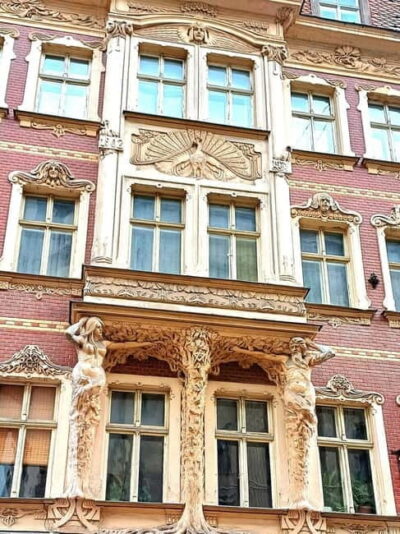
Ultimate Art Nouveau Experience in Riga – Private Tour
Read our review →Browse the lists this tour appears in