Reviewed · RIGA TOURS
Riga: Red Bus Hop-On Hop-off Sightseeing Grand Tour
See Riga before choosing where to linger. This bus tour gives you a useful first look at Riga’s Old Town, Art Nouveau District, and Central Market, while the upper deck offers broad views across the Daugava River. I also like the choice of 12 audio languages and the chance to use the ticket for up to 48 hours.
The main drawback is the schedule. Buses may arrive about every hour in summer and every 90 minutes in the cooler months, so this is not a quick hop-off-and-on service at every stop. At $29, it offers fair value if you use it to cover several districts, but it can feel costly if you only ride the one-hour circuit.
In This Review
- Key points to know before riding
- Starting at Triangula Bastion beside Riga’s Old Town
- Crossing the Daugava through Pārdaugava
- The city centre, from Freedom Monument to Opera House
- Riga Central Market and the harbor route
- Riga’s Art Nouveau streets and Alberta Street
- What the two routes mean for your schedule
- The audio guide: useful, but not perfectly timed
- Comfort, views, and the practical bus experience
- Is $29 a fair price for Riga?
- Who should book this Riga bus tour?
- Final verdict: a useful first ride, not a complete Riga visit
- FAQ
- Where does the Riga hop-on hop-off bus depart?
- How long is the complete bus tour?
- How often do the buses run?
- How long is the ticket valid?
- Which languages are available for the audio commentary?
- What sights does the route include?
- How do I use my voucher?
Key points to know before riding
- Triangula Bastion is the starting point: Find the bus stop at 11 November Embankment, beside Riga’s Old Town.
- Three sides of Riga in one ride: The routes link Pārdaugava, the city centre, and the Art Nouveau area.
- More than 80 sights pass by: You will see the Freedom Monument, Opera House, Powder Tower, ferry terminal, Central Market, and much more.
- Two route patterns may apply: The service is described as red and blue circuits, with both taking about 1.5 hours together.
- Audio commentary comes in 12 languages: English, German, French, Finnish, Italian, Spanish, Norwegian, Russian, Latvian, Lithuanian, Swedish, and Polish are listed.
- Use the pass strategically: It is best for covering ground first, then returning on foot to the places you want to explore.
Starting at Triangula Bastion beside Riga’s Old Town
The main stop, called Stop A, is near Triangula Bastion at 11 November Embankment, address 11.Novembra Krastmala 17. This is a practical starting point because you are right beside the Old Town and close to the Daugava River.
The double-decker buses depart between 9:45 AM and 3:45 PM. In the high season, from June through September, an additional bus is scheduled about every 60 minutes from Triangula Bastion. From October through May, the gap can stretch to about 90 minutes.
That timing matters. You can ride the full circuit without getting off in roughly 60 minutes, but a real hop-on hop-off day requires patience. If you get off at the wrong stop, you might wait quite a while for the next bus.
Show your booking number to the driver and exchange the voucher on the bus. The supplied information refers to the ticket as valid for two days, up to 48 hours, while the activity summary also calls it a one-day pass. Because that wording is inconsistent, confirm the exact validity when you board. The important practical point is that the pass is intended to give you extended use after first activation.
Other Riga days to weigh up
- Riga: Canal Boat Sightseeing Tour With Audio guide
★ 4.5 · 1,827 reviews - Riga: Entrance Ticket – House of the Black Heads
★ 4.6 · 1,096 reviews - Riga: Guided Old Town Walking Tour
★ 4.8 · 1,049 reviews
Crossing the Daugava through Pārdaugava
The first section heads toward Pārdaugava, the district on the left bank of the Daugava. From the bus, you get a different view of Riga than you do from the Old Town streets. The river opens the city up, and the route gives you a chance to see the church towers and older buildings gathered across the water.
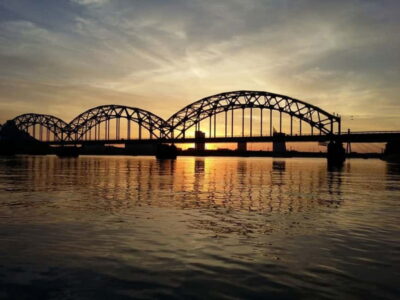
Crossing the Stone Bridge is one of the best moments on the ride. Look back toward the Old City for the broad panorama of Riga, sometimes described as the City of the Golden Cockerels because of the weather vanes that top several church towers.
This is a good reason to sit upstairs if the weather allows. The view is wider, and you can better understand how the river divides the city. On a cold or wet day, the lower deck is more comfortable, but windows and passing traffic can make photographs harder.
Pārdaugava is less immediately concentrated than the Old Town. I would not treat this section as a list of must-see stops. Its value is the view across the river and the sense of Riga’s layout. It helps you see the city as more than a compact medieval centre.
The city centre, from Freedom Monument to Opera House
After crossing back toward the centre, the bus passes through the Boulevard Ring. This green corridor circles much of central Riga and links several of the city’s main public buildings and monuments.
The Freedom Monument is one of the key sights along this section. It commemorates Latvian independence and is one of the most recognizable symbols in the city. The bus gives you an easy first look, but you will want to get off if you wish to examine the monument closely.
The Opera House is another major landmark on the central route. Its location near the canal and park area makes it easy to combine with a walk through the centre. The bus commentary helps identify the buildings as you pass, though the timing of the narration does not always match the exact building outside your window.
That mismatch is worth knowing in advance. The recorded commentary is useful for orientation and background, but it is not the same as a live guide pointing at a facade at the perfect moment. Keep your eyes outside and treat the audio as an extra layer rather than your only source of information.
The Powder Tower adds a medieval note to the ride. It is one of the surviving parts of Riga’s old defensive system and helps explain the transition between the city’s fortified past and its later growth beyond the walls.
Riga Central Market and the harbor route
The tour also passes Riga Central Market, one of the city’s most important food and trading places. It is described as the largest covered market in Europe, and the enormous former Zeppelin hangars give it an unusual appearance.
This is one of the stops where getting off can make the ticket more worthwhile. A drive past the market shows you the scale, but walking through the halls lets you see the everyday side of Riga: food stalls, local shopping, and the practical rhythm of city life. The bus tour cannot reproduce that experience, so plan time on foot if the market interests you.
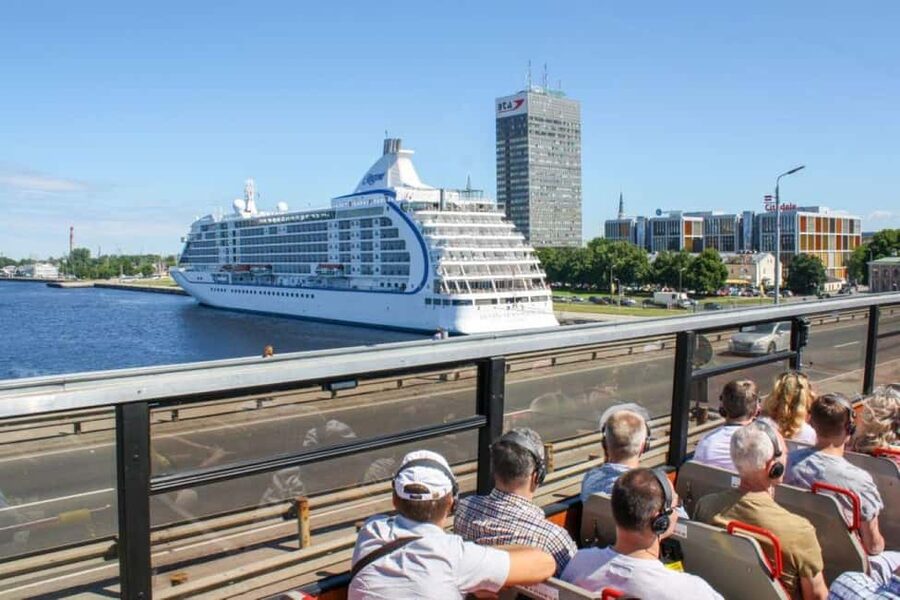
The route also reaches the harbor and Riga Ferry Terminal. This section gives you a look at the city’s connection with the Baltic Sea and the working edge of the centre. It is not as visually compact as the Old Town, but it adds useful context. You see where ferries arrive and depart, rather than viewing Riga only as a collection of historic facades.
If you are staying near the Old Town, the harbor section can save you a separate walk. If you have limited time, it may be better to remain on the bus and use the ride as a scenic orientation loop.
A different sort of day out of Riga altogether:
- From Riga: Hill of Crosses and Jelgava Gems Tour
★ 4.8 · 1,040 reviews - From Riga: Hill of Crosses & Jelgava Guided Tour
★ 4.9 · 685 reviews - Riga Package: Canal Boat Tour + Drink & Old Town Audio Guide
★ 4.3 · 659 reviews - Riga: Canal Boat Tour with Welcome Drink & Audio Guide
★ 4.5 · 565 reviews
Riga’s Art Nouveau streets and Alberta Street
The strongest architectural part of the tour comes in the central Art Nouveau district. Riga is known for its decorative facades, and the bus lets you cover a large section quickly.
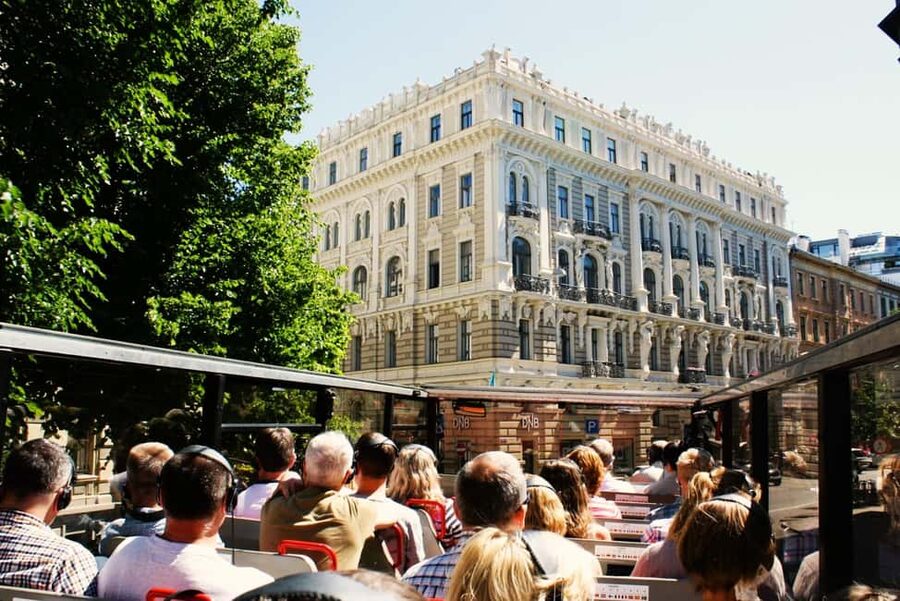
Expect a striking mix of styles, from restrained Romantic details to heavily decorated Art Nouveau. Stone masks, mythical creatures, curling ornaments, and elaborate windows appear across the facades. The buildings often compete for attention, with one dramatic front followed by another.
Alberta Street is the essential highlight. Its buildings are closely linked with the architect Mikhail Eisenstein, whose work is known for theatrical decoration and strong vertical lines. From the bus, you get the quick overview. On foot, you can stop, look upward, and compare the details from one facade to the next.
This is a clear case where I would use the bus as an introduction, not a replacement for walking. The Art Nouveau district is included within Riga’s UNESCO-listed architectural heritage, and the details are the point. A photograph from a moving upper deck cannot show every mask, column, or sculpted figure.
Still, the bus has a real advantage here. It connects the architectural district with the river, centre, market, and Old Town without asking you to arrange several separate rides. That makes it useful early in your visit, especially if you have only a day or two in Riga.
What the two routes mean for your schedule
The service is described as covering two routes, commonly identified as red and blue. One recent description puts the red and blue lines at about one hour each, or roughly 1.5 hours in total when used together. The full ride without stops is also listed as approximately 60 minutes, so timetable details may vary by circuit and season.
That uncertainty means you should not plan a tight connection to a train, ferry, or airport transfer. Use the bus when you can accept a flexible schedule.
The best approach is simple:
- Take one complete circuit first, without getting off.
- Mark the places you want to revisit.
- Get off near the Old Town, Central Market, or Art Nouveau streets.
- Check the next departure time before leaving the bus.
- Use the second route or the following day for anything you missed.
The printed route guide and Riga map are useful, but stop signs may not always be easy to spot from the street. Keep the route details with you, and ask the driver if you are unsure. Drivers are described as polite and helpful, which is useful when the stop markings or leaflet timing leave you uncertain.
The audio guide: useful, but not perfectly timed
The recorded commentary is available in 12 languages, including English, German, French, Finnish, Italian, Spanish, Norwegian, Russian, Latvian, Lithuanian, Swedish, and Polish. This is a strong feature for a city tour because you can follow along without relying on a live guide in one language.
The commentary gives background on the city and its major buildings. It is especially helpful on the first circuit, when you are still learning the names and positions of Riga’s main sights.
Do not expect every sentence to line up exactly with the building outside. The narration can seem early or late, and one audio channel may be easier to hear than another. Test the headphones before the bus leaves, and change seats if the selected language does not come through properly.
The audio also could do more to tell you when to get off. It identifies sights, but you should not assume that every important stop will be presented as a clear invitation to explore. Use the map and your own plan.
Comfort, views, and the practical bus experience
The double-decker format gives you two useful choices. The upper deck offers the best view of the skyline, river, church towers, and ornate facades. The lower deck is the safer choice in poor weather and may be more comfortable when the wind is strong.
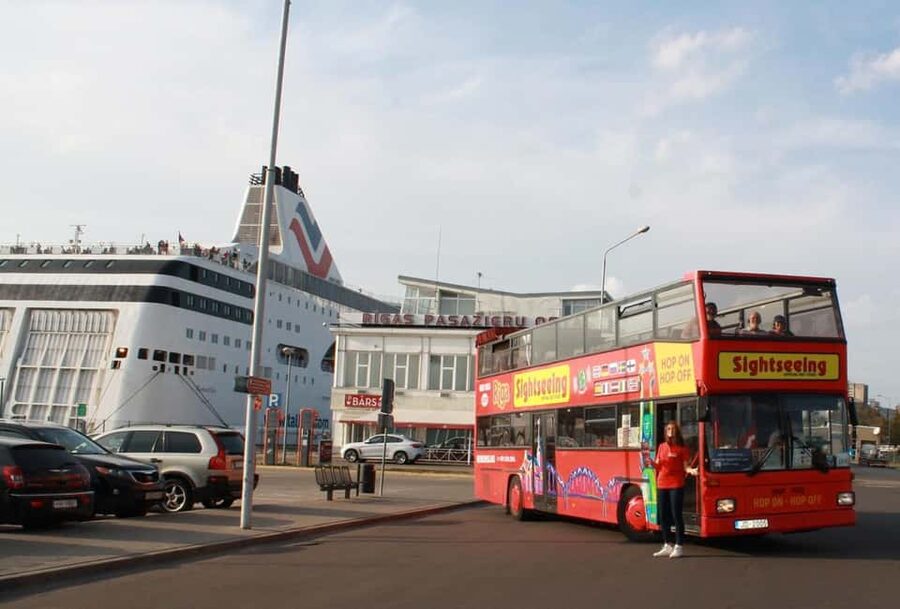
The buses are described as comfortable, though the vehicle may sometimes be a smaller minibus rather than the large red double-decker you picture from the title. That matters if you are expecting a particular style of sightseeing vehicle.
The service is highly visible, so you are unlikely to miss the bus once you know the stop. The harder part is finding each stop away from Triangula Bastion. Some stops are not clearly marked, and the route leaflet can be confusing about departure times.
Take a screenshot of the route information before setting off. Note the stop name where you get off. That small habit can save you from wandering around Riga trying to find the return point.
Is $29 a fair price for Riga?
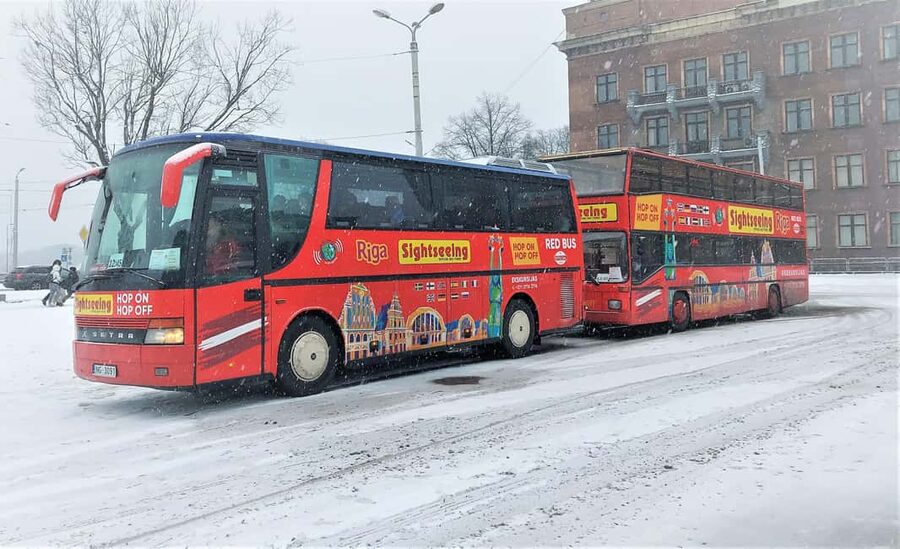
At $29 per person, the tour is not the cheapest way to see a compact city. Riga’s Old Town, central parks, Freedom Monument, and Art Nouveau streets can largely be explored on foot.
The price makes more sense if you use the bus for its full purpose. You are paying for transport between three districts, the river crossing, the harbor, the Central Market area, a city map, route information, and audio commentary in a wide range of languages. The pass also gives you up to 48 hours according to the ticket information, which can improve the value.
I would consider it worthwhile for a first visit, for anyone who prefers not to walk long distances, or for families who want an easy overview. It is also useful on a short city break when you want to see Pārdaugava and the harbor without arranging separate transport.
I would hesitate if your plan is simply to ride once and remain on board. Since Riga’s centre is fairly compact, a single one-hour loop can feel expensive. The best value comes from riding, getting off, exploring, and riding again.
Who should book this Riga bus tour?
This is a good match if you want a structured first look at Riga. It suits you if you are visiting for one or two days, want to cover more than the Old Town, or prefer commentary while you get your bearings.
Families may like the easy format, especially children who tire during long walking tours. The raised viewpoint and bright bus also make the ride more entertaining than a standard city transfer.
The tour is less suitable if you want a detailed architectural tour led by a person. The audio is informative, but it cannot answer questions or adjust the pace. It is also not ideal for a rigid itinerary because buses may be an hour apart in summer and 90 minutes apart from October through May.
Book only if you plan to use the route as transportation as well as sightseeing. Ride the full loop first, then spend your time on foot at Central Market, the Old Town, and Alberta Street. That is how the $29 fare begins to earn its keep.
Final verdict: a useful first ride, not a complete Riga visit
I would recommend the Riga Red Bus Hop-On Hop-Off Grand Tour as an orientation tool. Its best features are the broad city coverage, the river panorama from the Stone Bridge, the Art Nouveau route, and the multilingual commentary.
I would not use it as your only Riga experience. The recorded information can drift out of sync, stops are not always obvious, and the wait between buses limits spontaneous hopping. Treat the bus as your city map on wheels, then get off and explore the places that catch your eye.
For a short visit, a first-time visit, or a family trip, book it. For a visitor who enjoys walking and plans to remain in central Riga, compare the price with simply exploring on foot.
FAQ
Where does the Riga hop-on hop-off bus depart?
The main departure point is Stop A, near Triangula Bastion at 11.Novembra Krastmala 17, beside Riga’s Old Town.
How long is the complete bus tour?
The full tour without stops takes approximately 60 minutes. The service is also described as having red and blue routes that together take about 1.5 hours.
How often do the buses run?
From June through September, an additional bus departs from Triangula Bastion about every 60 minutes. From October through May, departures are about every 1.5 hours.
How long is the ticket valid?
The ticket information says it is valid for two days, up to 48 hours, after activation. The activity is also described as valid for one day, so confirm the exact validity with the driver when you exchange your voucher.
Which languages are available for the audio commentary?
The audio commentary is available in English, German, French, Finnish, Italian, Spanish, Norwegian, Russian, Latvian, Lithuanian, Swedish, and Polish.
What sights does the route include?
The route passes through Pārdaugava, Riga’s city centre, and the Art Nouveau district. Sights include the Freedom Monument, Opera House, Powder Tower, Central Market, Riga Ferry Terminal, the Old Town panorama, and Alberta Street.
How do I use my voucher?
Show your booking number to the bus driver and exchange the voucher on the bus. The tour includes a Riga city map and detailed route information.
New on the site around Riga
- Wooden Riga on foot -Ķīpsala★ 5.0 · 2 reviews
- Vilnius Day Trip or Airport Transfer★ 5.0 · 2 reviews
- Ultimate Art Nouveau Experience in Riga – Private Tour★ 5.0 · 4 reviews
- The Best Of Riga Walking Tour★ 5.0 · 2 reviews
- Tour from Riga to Vilnius: Bauska Castle, Rundale Palace and The Hill of Crosses★ 5.0 · 3 reviews
- Private Transfer to anywhere in Riga Center★ 5.0 · 2 reviews
- Taste Riga – Private Tour of Latvian Flavour★ 5.0 · 5 reviews
- Neigbourhoods of Riga: Honest tour through most beautiful and most unusual areas★ 5.0 · 2 reviews
Riga Tours, compared.


Riga Package: Canal Boat Tour + Drink & Old Town Audio Guide
Read our review →
Canal Boat Tour with Welcome Drink & Audio Guide
Read our review →