
Reviewed · OLD TOWN TOURS
2 Hours Walking Tour in Legends and Secret of Riga’s Old Town
Riga rewards curious walkers. This private Old Town tour mixes famous sights with odd little stories, forgotten passages, medieval symbols, and local legends that are easy to miss on your own. I like the private format, which lets Lina adjust the pace and answer questions, and I like the tasting of Riga Black Balsam, a useful introduction to Latvia’s famously strong herbal drink. The main consideration is time: with roughly 25 stops over about two and a half hours, some places receive only a quick look.
Lina’s greatest strength is the way she connects buildings to people, customs, and political events. She also uses a folder of historical photographs to show how Riga’s churches and streets changed after fires and wartime destruction. You should wear good walking shoes, and keep in mind that church visits usually cover the free areas or exterior views rather than full paid admission.
In This Review
- The five things to know before you book
- Why this private Riga walk is useful on a first visit
- St. Peter’s Church and Town Hall Square: symbols at the heart of Riga
- The Black Heads, Roland, and Riga’s merchant past
- Narrow streets, old cellars, and the Bremen musicians
- Dome Square, Riga Cathedral, and a Venetian surprise
- Three Brothers, St. Jacob’s, and the city’s harsher rules
- Swedish Gate, Jacob’s Barracks, and Riga Black Balsam
- Freedom Monument, Laima Clock, and Riga’s shorter streets
- The Baltic Way, Russian theatre, and the oldest lanes
- Price, timing, and what you really receive
- Who should book this Riga Old Town tour?
- Should you book it?
- FAQ
- How long does the Riga Old Town walking tour last?
- How many people can join the private tour?
- Is Riga Black Balsam tasting included?
- Where does the tour start?
- Are church and museum entrance fees included?
- Can I cancel the tour for a full refund?
The five things to know before you book
- Private tour for up to six: The $108.43 group price can be good value for a family or small party, especially with several people sharing the cost.
- Lina brings stories, not just dates: Her explanations include legends, medieval customs, wartime photographs, symbols, and practical advice for museums and restaurants.
- Black Balsam tasting included: You get a sample of Riga’s signature herbal liqueur at a souvenir shop or Black Magic Bar.
- A fast Old Town orientation: The route covers churches, guild halls, squares, defensive walls, monuments, and short streets, making it useful early in your stay.
- Expect a walking-heavy route: The tour lasts about 2 hours 30 minutes and includes many stops, with limited time at each one.
- The free areas matter: Several historic interiors are viewed from outside or through publicly accessible sections, so this is not a full museum or church-entry tour.
Why this private Riga walk is useful on a first visit
Riga’s Old Town is compact, but its story is not simple. German merchants, Hanseatic trade, Swedish rule, Russian imperial influence, Soviet occupation, and modern Latvian independence all left marks on the same few streets. A good guide helps you see those layers instead of treating the center as a collection of pretty façades.
This tour is especially useful if you have only a day in Riga, are arriving from a cruise, or want a clear map of the center before choosing museums and restaurants. The route covers a great deal, from St. Peter’s Church to the Freedom Monument and the Cat House. It also includes places that can be hard to interpret without help, such as Rozena iela, the old fortification wall, and the Baltic Way memorial.
The pace is described as suitable for most people and generally low-key, but the schedule is still ambitious. Twenty-nine listed points, including a Russian theatre and the First Christmas Tree Marker, mean you should expect short explanations at several stops. You are getting breadth and local stories rather than long visits inside each building.
More Old Town walks in Riga:
- Riga: Guided Old Town Walking Tour
★ 4.8 · 1,049 reviews - Riga Package: Canal Boat Tour + Drink & Old Town Audio Guide
★ 4.3 · 659 reviews - Riga: Old Town Walking Tour with Art Nouveau Highlights
★ 4.7 · 332 reviews
St. Peter’s Church and Town Hall Square: symbols at the heart of Riga
The walk begins around St. Peter’s Church, Riga’s oldest Lutheran church. You view the main building from outside, then visit its free area. Lina explains the medieval tradition of the golden roosters and their Christian meaning, along with the strange role that the number 666 played in the church’s fate.
That opening sets the tone. This is not only an architecture walk. You will hear about belief, superstition, civic pride, and the small details that make an old building memorable. If you want tower access or a full church visit, ask what is available separately, since the included portion is limited.
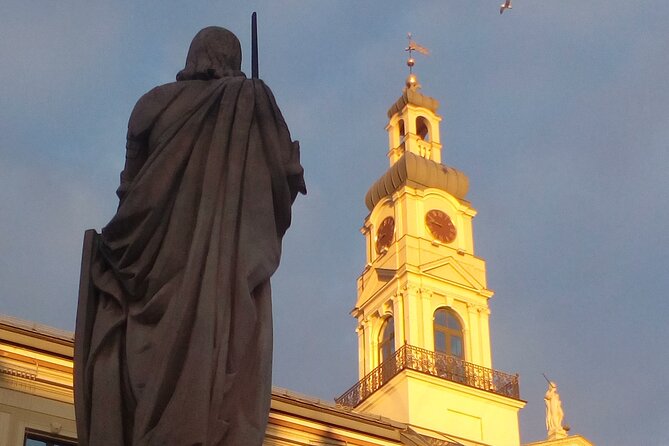
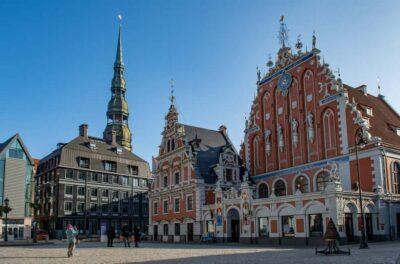
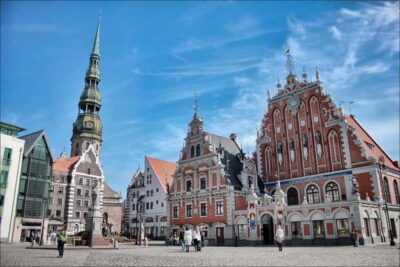
At Riga Town Hall Square, or Ratslaukums, the focus shifts from religion to city life. The square began as a market and later became an administrative and ceremonial center. From here, you can look toward the Daugava River, the Latvian National Library, and the Museum of the Occupation of Latvia.
Lina also explains the Key to Riga, the city’s Christmas tree tradition, and the memorial marking the first decorated Christmas tree in 1510. Riga is sometimes called a city of four capitals because different stories connect it with Christmas trees, Hanseatic trade, Latvian independence, and other civic traditions. This is the kind of detail that gives the city a personality beyond its architecture.
The Black Heads, Roland, and Riga’s merchant past
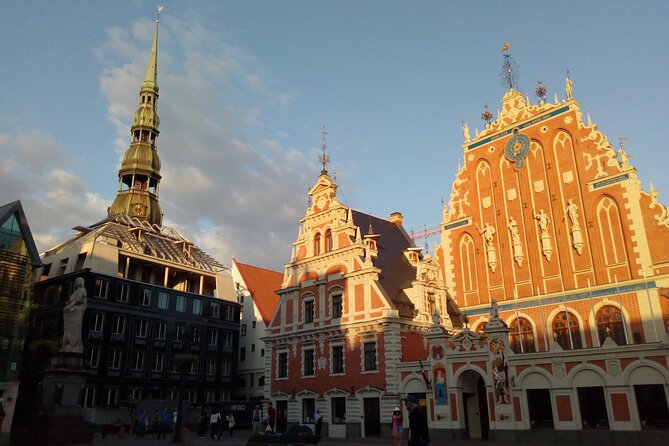
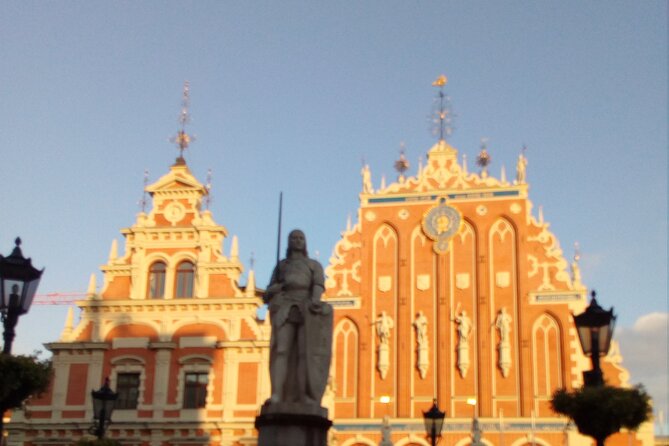
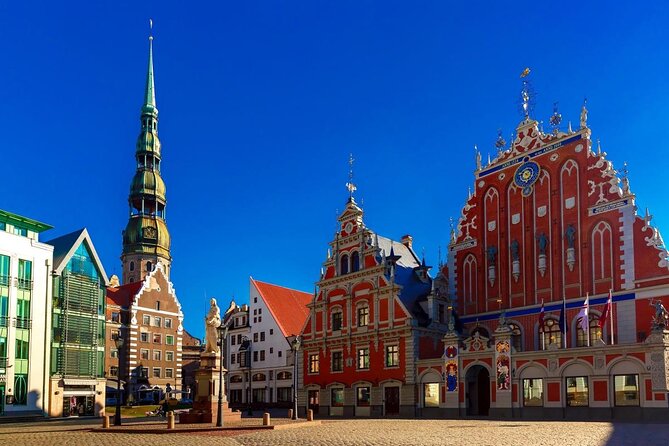
The House of the Black Heads is one of Riga’s most ornate buildings. It was connected with the Brotherhood of the Black Heads, a group of unmarried merchants and shipowners. Lina points out the façade decoration, the clock, and the alchemical and hermetic symbols worked into the design.
You also visit the free part of the building and may see its underground areas. The lower spaces help explain how old Riga was built and rebuilt over time. Historic buildings here are not always neat, self-contained monuments. They can include cellars, passages, and layers beneath the current street level.
In the square, Roland’s statue represents medieval civic freedom and Riga’s place in the Hanseatic world. Riga joined the Hanseatic League in 1283, and the statue’s shield and sword carry their own story. This short stop is a good example of the tour’s method: Lina gives a symbol a backstory, so you are not simply taking a photograph of a figure in the middle of a square.
The passage by Riga City Hall includes Jaunavu Street and a waterfall called River of Time, installed for Riga’s 800th anniversary in 2001. You will also see a contemporary work connected with Pharaoh Tutankhamen. These quick sights add variety, though the brief timing means you should not expect a long art explanation.
Narrow streets, old cellars, and the Bremen musicians
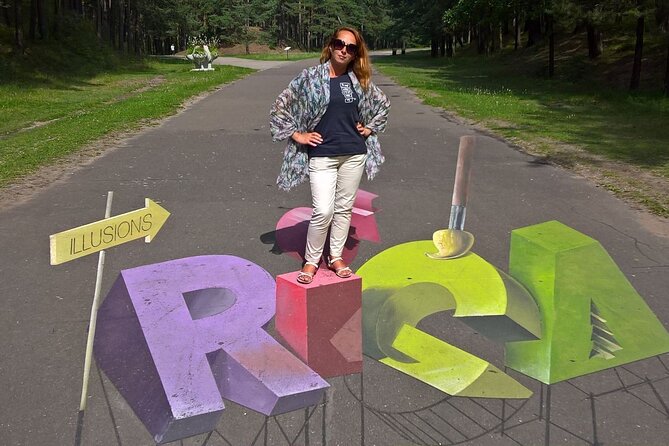
Rozena iela is said to be Riga’s narrowest street. You see the old City Hall wine cellar from outside and hear why certain tight lanes were once called the streets of the drunk knight. It is a small stop, but it helps you picture medieval Riga as a crowded trading town rather than a polished tourist district.
At the Bremen Town Musicians monument, you see the famous sculpture of a donkey, dog, cat, and rooster. Bremen gave it to Riga in 1990, reflecting the sister-city connection between the two places. Bishop Albert, the founder associated with Riga, came from Bremen, adding another link between the cities.
The monument is also tied to a local wish-making custom. You can make your own wish while looking at the animals, though the tour cannot promise results. The stop works well for families because the sculpture is playful, easy to understand, and linked to a real civic relationship.
More walking tours in Riga:
- Riga Old Town walking tour
★ 4.5 · 304 reviews - Riga: Old Town Walking Tour in a Small Group or Private
★ 4.7 · 254 reviews - Riga: Private Walking Tour with a Local
★ 4.7 · 168 reviews - Best of Riga Walking Tour – Highlights and Hidden Gems
★ 5.0 · 147 reviews
Dome Square, Riga Cathedral, and a Venetian surprise
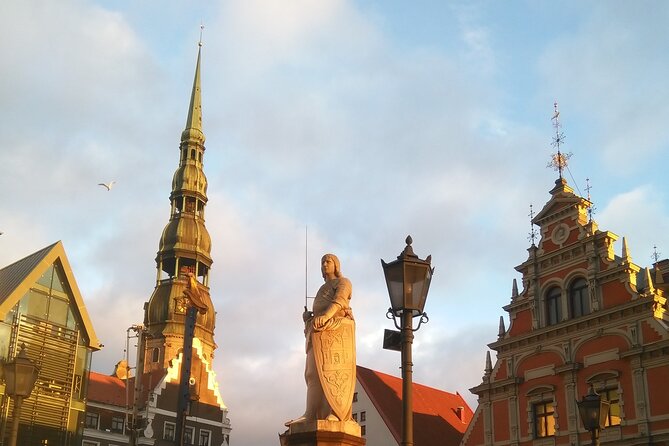
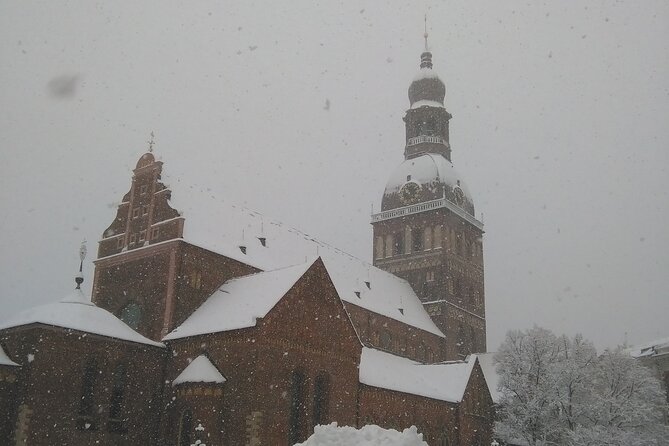
Dome Square is Riga’s largest Old Town square and the setting for the main Christmas market. From here, Lina explains the geometry and symbolism of the space and has you count the golden roosters visible around Riga’s churches.
At Riga Cathedral, you learn about the church’s foundation and construction, then visit the free part of the building. Lina discusses its pipe organ, once the largest in the world during the 19th century and still regarded as one of the finest sounding instruments. She also points out the last work of Rafael Santi connected with the cathedral.
The rooster appears again in a practical story. Merchants once used the cathedral’s rooster to help plan their day. These details make the skyline useful, not merely decorative.
The nearby Riga Stock Exchange Building adds an unexpected visual change. Its Venetian Neo-Renaissance design contains the only Venetian gondola in Riga, and the building now houses a museum of foreign art. You view the architecture and pass through the building area, but museum entry is not the main purpose of this walk.
Three Brothers, St. Jacob’s, and the city’s harsher rules
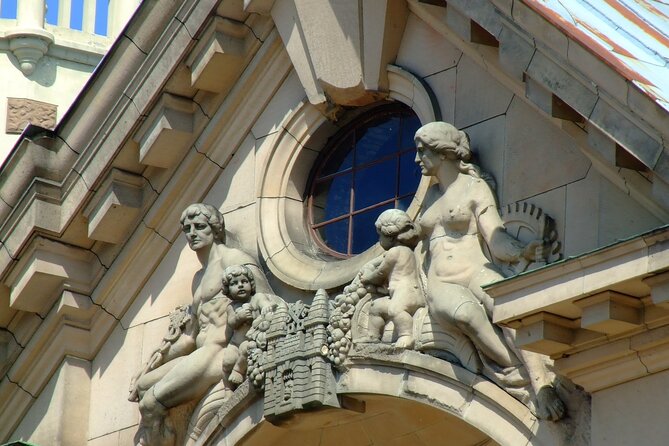
The Three Brothers form Riga’s oldest surviving group of dwelling houses. Each represents a different period of residential construction. You visit the oldest brother, dating from the 15th century, and the Latvian Museum of Architecture.
The inner yard contains the oldest coat of arms of Riga. Lina also explains the medieval window tax, an amusing detail with an unpleasant practical effect: taxes could influence the size and number of windows in a home. This stop is particularly good for understanding how ordinary people lived, not only how guild leaders and churches shaped the city.
St. Jacob’s Catholic Cathedral is viewed from outside. Its bell has a grim nickname and a grim purpose: the bell of the poor sinners rang when a condemned criminal was taken from prison to Town Hall Square for execution. It is a reminder that medieval public life included punishment and spectacle as well as trade and ceremony.
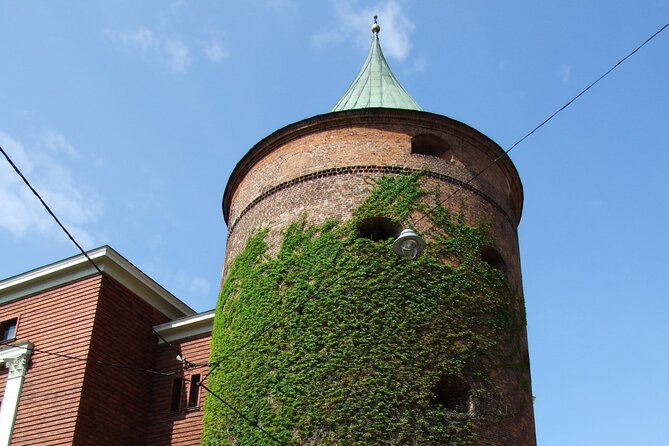
The Powder Tower is the largest and only surviving tower from Riga’s 14th-century defensive system. You see it from outside, and the Latvian War Museum inside the tower can be visited free of charge after the tour. That makes it a useful place to return to if military history interests you.
Swedish Gate, Jacob’s Barracks, and Riga Black Balsam
Swedish Gate is Riga’s only surviving outer gate. It dates from the Swedish period of the city’s past, and Lina points out the house associated with the city executioner. You will also hear the legend of the Riga ghost, one of the tour’s more atmospheric stories.
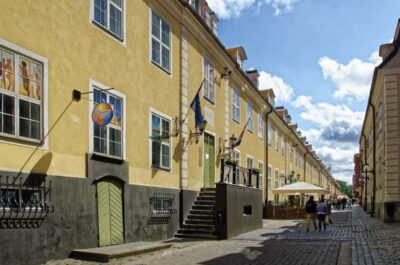
Jacob’s Barracks is a long building that once housed 5,000 Swedish soldiers. Today, its rooms hold souvenir shops, cafés, restaurants, and offices. The contrast is clear: military lodging has become part of the everyday Old Town commercial scene.
The Black Magic Bar is one of the tour’s most enjoyable stops. Local legend connects the site with an old pharmacy where Riga Black Balsam was invented in the 18th century. You can sample the drink, and the café also serves coffee, tea, sweets, cakes, and other drinks made with different kinds of Black Balsam.
Lina explains the drink’s alchemical symbolism and points out a secret door leading toward the laboratory of Abraham Kunze, the figure associated with its invention. The tasting is included, but this is not a full meal or a long bar visit. You will want to return later if the cakes, cocktails, or the dark historical setting appeal to you.
Freedom Monument, Laima Clock, and Riga’s shorter streets
The Freedom Monument was built during Latvia’s first republic and remains one of the country’s most important national symbols. Lina explains its history and hidden symbolism, including why it matters so much to Latvian identity.
The nearby Laima Clock is Riga’s main meeting point. Laima is Latvia’s largest chocolate producer, and the tour explains how the clock received its name. It is a practical landmark to remember if you arrange to meet someone in the center.
You then pass through Ķēniņu iela, described as Riga’s shortest street. The route also reaches the Cat House, one of the Old Town’s most recognizable buildings. Its black cats have inspired a popular legend, and the story explains how the cat became one of Riga’s symbols.
At Livu Square, Lina discusses the square’s history and hidden meaning, including the monument showing a Liv head. The Small Guild introduces the city’s craftsmen, while the Great Guild represents Riga’s merchants. The Great Guild existed from 1354 to 1936 and reflects the power of German merchant organizations in a city that joined the Hanseatic League in 1283.
The Baltic Way, Russian theatre, and the oldest lanes
The Baltic Way Footprint Monument is small, but its subject is enormous. On August 23, 1989, around two million Latvians, Estonians, and Lithuanians joined hands in a human chain stretching about 600 kilometers from Tallinn through Riga to Vilnius. The action protested the 50th anniversary of the Molotov-Ribbentrop Pact while the three countries were still under Soviet occupation.
The red granite footprint near Kaļķu and Vaļņu streets gives you a quiet place to remember that event. It is easy to miss without a guide.
The route also passes one of the oldest Russian theatres outside Russia, built during the Russian Empire in the second half of the 19th century. Its Florentine Neo-Renaissance design adds another chapter to Riga’s architectural mix.
At St. John’s Church, you hear the sad story of two Dominican monks who were walled up alive. During 19th-century reconstruction, their remains were reportedly found in the church wall. The tour also shows the oldest gate leading toward the former Dominican monastery.
You then see part of Riga’s 13th-century fortification wall, built by Germans during the Livonian Order period. Kalēju iela, or Blacksmiths Street, follows the line of what was once an embankment along the Riga River. This is a clever way to understand the old city’s vanished waterways.
The Riga Radio and TV Tower appears in the distance. At 368.5 meters, it is the tallest tower in the European Union and was built from 1979 to 1989 with funding from the Soviet central government. The final stop is the plaque for the first decorated Christmas tree in 1510, bringing the route back to one of Riga’s most unusual claims.
Price, timing, and what you really receive
The price is $108.43 per group of up to six. For six people, that works out to about $18 per person. For two people, it is roughly $54 each, and for a solo visitor it is a much larger outlay. The private setup makes the price easier to justify for families and small groups who want a personal pace and direct access to the guide.
The tour is listed as about 2 hours 30 minutes, despite the shorter title. The listed stop times add up to much less than that, which is normal for a walking route with travel between locations, questions, photographs, and extra explanations. Past tours with Lina have sometimes lasted close to three hours, so keep a little flexibility afterward.
Pickup is offered, and the stated meeting information names both the Grand Palace Hotel at Pils Street 12 and St. Peter’s Church near Reformacijas laukums. Confirm the exact starting point when booking, especially if you are relying on hotel pickup.
Free cancellation is available up to 24 hours before the start time. The activity is offered in English, uses a mobile ticket, and operates Monday through Sunday from 10 a.m. to 6 p.m. The route is near public transportation, and most people can participate.
Who should book this Riga Old Town tour?
I would choose this tour early in a Riga visit if you want orientation, local stories, and a long list of places to revisit. Lina is warm, well prepared, and generous with explanations. Her historical photo folder is especially helpful when a building’s current beauty hides a past fire or wartime damage.
It suits families, couples, cruise visitors, and anyone who prefers a private guide to a large group. It also works for people who enjoy legends, symbols, architecture, and small urban details more than formal museum lectures.
You may want another type of tour if your priority is extended interior visits, a slow architectural study, or a meal-based experience. Several churches and landmarks are exterior stops or free sections, and the many short stops can feel crowded if you want to linger. Comfortable shoes are essential, and cold or wet weather will make the long walk harder.
Should you book it?
Book it if you want to get your bearings quickly and understand why Riga’s Old Town looks the way it does. The route covers the major sights, but its best moments are often the less obvious ones: the narrow lanes, old cellars, execution bell, underground spaces, Black Balsam traditions, and Baltic Way memorial.
For a group of four to six, the price is sensible, especially with a private guide and included tasting. Solo visitors should weigh the cost more carefully. If you book, schedule it near the start of your stay, wear sturdy shoes, and save Lina’s restaurant and museum suggestions for later. That is when this fast, story-filled walk pays off most.
FAQ
How long does the Riga Old Town walking tour last?
The experience lasts approximately 2 hours 30 minutes, although the title describes it as a two-hour tour.
How many people can join the private tour?
The price covers one private group of up to six people.
Is Riga Black Balsam tasting included?
Yes. An alcoholic beverage degustation of Riga Black Balsam is included, usually connected with the Black Magic Bar or a souvenir shop stop.
Where does the tour start?
The meeting information lists the Grand Palace Hotel at Pils Street 12 and St. Peter’s Church near Reformacijas laukums. Pickup is offered, so confirm the exact meeting arrangement when booking.
Are church and museum entrance fees included?
Several stops are outside or in free sections. The listed route does not provide full paid entry to every church or museum, and all fees and taxes are otherwise excluded.
Can I cancel the tour for a full refund?
Yes. You can cancel at least 24 hours before the local start time for a full refund. Cancellations or changes made less than 24 hours ahead are not refunded or accepted.
New on the site around Riga
- Wooden Riga on foot -Ķīpsala★ 5.0 · 2 reviews
- Vilnius Day Trip or Airport Transfer★ 5.0 · 2 reviews
- Ultimate Art Nouveau Experience in Riga – Private Tour★ 5.0 · 4 reviews
- The Best Of Riga Walking Tour★ 5.0 · 2 reviews
- Tour from Riga to Vilnius: Bauska Castle, Rundale Palace and The Hill of Crosses★ 5.0 · 3 reviews
- Private Transfer to anywhere in Riga Center★ 5.0 · 2 reviews
- Taste Riga – Private Tour of Latvian Flavour★ 5.0 · 5 reviews
- Neigbourhoods of Riga: Honest tour through most beautiful and most unusual areas★ 5.0 · 2 reviews
Old Town Tours, compared.
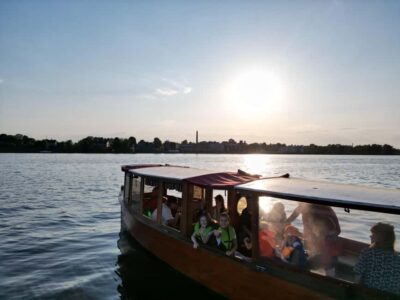
Riga Package: Canal Boat Tour + Drink & Old Town Audio Guide
Read our review →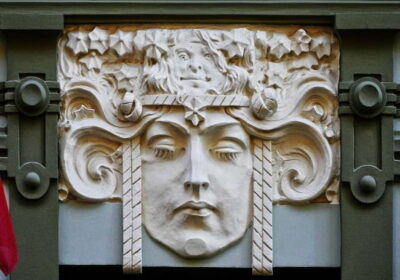
Old Town Walking Tour with Art Nouveau Highlights
Read our review →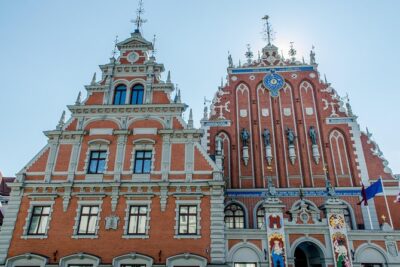
Old Town Walking Tour in a Small Group or Private
Read our review →
Old town pub & bar crawl, hidden gems, and local party
Read our review →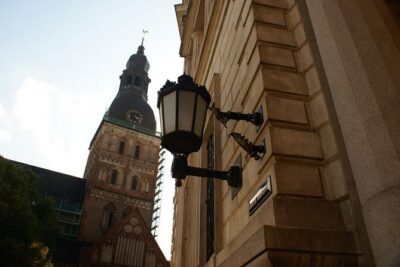
Browse the lists this tour appears in